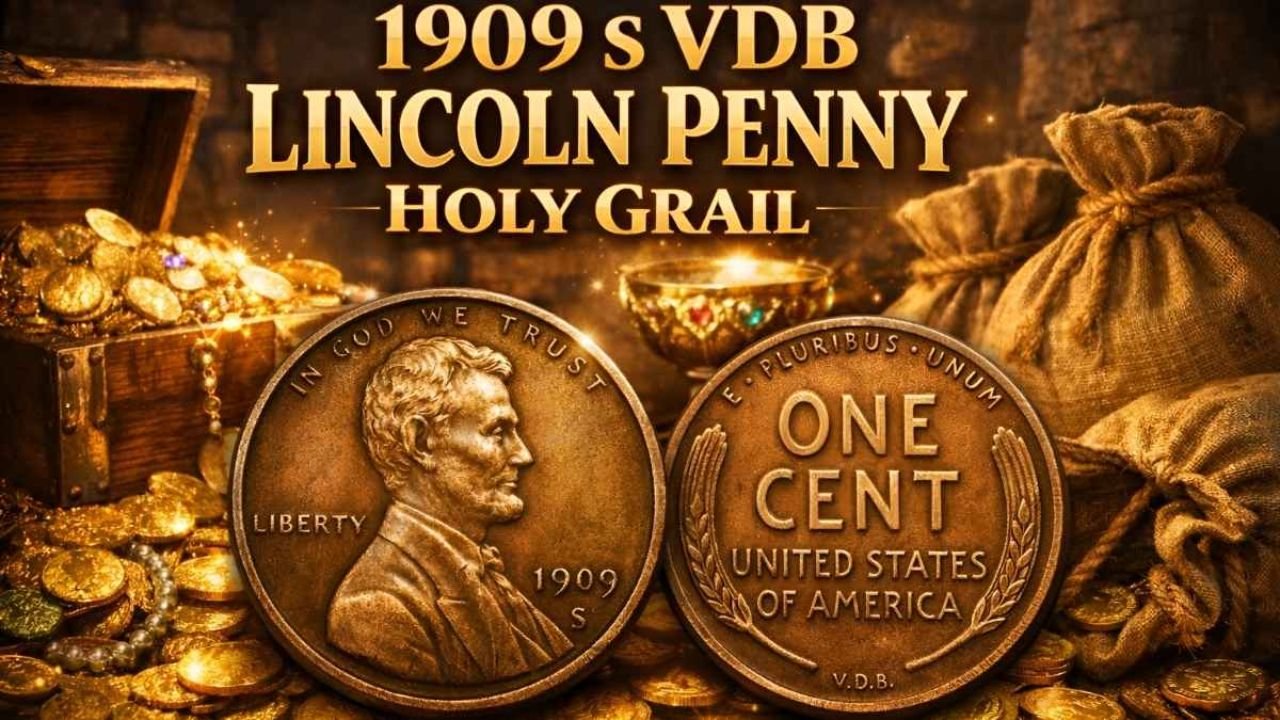
Few coins ignite imagination quite like the 1909-S VDB Lincoln penny. Often described as the “Holy Grail” of small-cent collecting, it combines history, controversy, scarcity, and enduring demand. Headlines occasionally attach astonishing figures—claims of $280 million—to this tiny copper coin.
While those valuations belong more to myth than market reality, the 1909-S VDB remains one of the most important and valuable coins in American numismatics.
The Birth of an American Icon
In 1909, the United States introduced the Lincoln Wheat Penny to commemorate the 100th anniversary of President Abraham Lincoln’s birth. It marked the first time a real historical figure appeared on a regularly circulating U.S. coin.
The coin was designed by sculptor Victor David Brenner. His initials, “VDB,” were placed prominently at the bottom of the reverse design beneath the wheat stalks.
Public criticism soon emerged, arguing the initials were too conspicuous. Responding quickly, the Mint removed them from subsequent production. That decision transformed a routine design adjustment into one of the most famous collecting stories in U.S. coinage history.
Why the 1909-S VDB Is So Rare
Two factors define the coin’s rarity: limited mintage and historical timing.
While millions of 1909 Lincoln cents were struck overall, only about 484,000 examples were produced at the San Francisco Mint bearing both the “S” mint mark and the “VDB” initials before their removal.
That figure is extraordinarily low for a circulating U.S. coin, especially for a denomination produced in the millions annually.
From the moment collectors realized production had stopped, many began saving examples. Even so, surviving high-grade coins remain scarce more than a century later.
The Reality Behind the $280 Million Claim
The idea that a single 1909-S VDB penny could be worth $280 million is purely speculative and unsupported by auction data.
In reality, values are impressive—but grounded.
- Circulated examples often trade for thousands of dollars.
- Well-preserved Mint State examples regularly command five-figure prices.
- Exceptional specimens graded at the highest levels have surpassed $100,000 at auction.
These figures are remarkable for a one-cent coin, but they fall far short of nine-digit territory.
The $280 million narrative persists because it captures public imagination. It transforms a small copper coin into a symbol of hidden fortune and fuels treasure-hunt excitement.
Auction Highlights and Market Performance
Over the decades, elite specimens have crossed major auction blocks, often generating competitive bidding among advanced collectors.
High-grade “Red” examples—meaning coins retaining original copper luster—are particularly prized. In top Mint State grades, they represent condition rarity layered atop already limited supply.
Market demand for the 1909-S VDB has remained stable for generations. It is considered a cornerstone coin—one that serious Lincoln cent collectors strive to own at some level.
Unlike speculative hype pieces, this coin has proven staying power supported by consistent collector demand.
Why Collectors Call It the “Holy Grail”
Several elements elevate the 1909-S VDB above other Lincoln cents.
Historic First-Year Issue
It represents the inaugural year of the Lincoln cent series, marking a significant shift in American coin design.
Controversial Design Story
The rapid removal of Brenner’s initials created instant scarcity and intrigue.
Low Mintage
With fewer than half a million struck, supply has always been limited.
Universal Recognition
Even non-collectors often recognize the date as significant, reinforcing its cultural prominence.
Together, these factors give the coin prestige beyond its denomination.
How to Identify a Genuine 1909-S VDB
Because of its value, the coin has been widely counterfeited and altered. Some common 1909 pennies have had mint marks added, while others have had initials engraved fraudulently.
A genuine 1909-S VDB penny displays:
- The “S” mint mark beneath the date on the obverse
- “VDB” initials at the bottom center of the reverse
- Correct spacing, font style, and alignment consistent with authentic dies
Authentication by a reputable third-party grading service is essential for high-value examples. Certification protects buyers and preserves long-term liquidity in the marketplace.
Cultural Impact Beyond Its Value
The 1909-S VDB Lincoln penny occupies a unique space in American culture. It represents more than scarcity; it embodies the romance of discovery.
Stories of rare coins found in old collections or inherited jars keep interest alive. Even though the likelihood of uncovering a six-figure example in circulation is slim, the possibility—however remote—sustains enthusiasm.
In many ways, the coin symbolizes the broader appeal of numismatics: the intersection of history, artistry, and financial potential.
Investment Perspective in 2026
In today’s market environment, tangible historical assets continue attracting interest from collectors and investors seeking diversification.
The 1909-S VDB penny remains one of the most liquid and widely recognized key dates in U.S. coinage. Its century-long demand base provides stability that many modern speculative coins lack.
However, buyers should focus on:
- Verified authenticity
- Strong eye appeal
- Original surfaces
- Certified high-grade examples
Quality remains the primary driver of long-term performance.
The Enduring Allure
Despite exaggerated headlines, the true value of the 1909-S VDB Lincoln penny lies not in mythical nine-digit claims, but in its documented rarity and cultural resonance.
It is a coin born from celebration, shaped by controversy, and elevated by scarcity. More than a century after its release, it continues to inspire collectors worldwide.
Whether valued at a few thousand dollars or over one hundred thousand, it stands as a testament to how a single design decision can create lasting legend.
The $280 million myth may endure in imagination, but the real treasure is the coin’s place in history—a small copper piece that became one of America’s most celebrated numismatic icons.