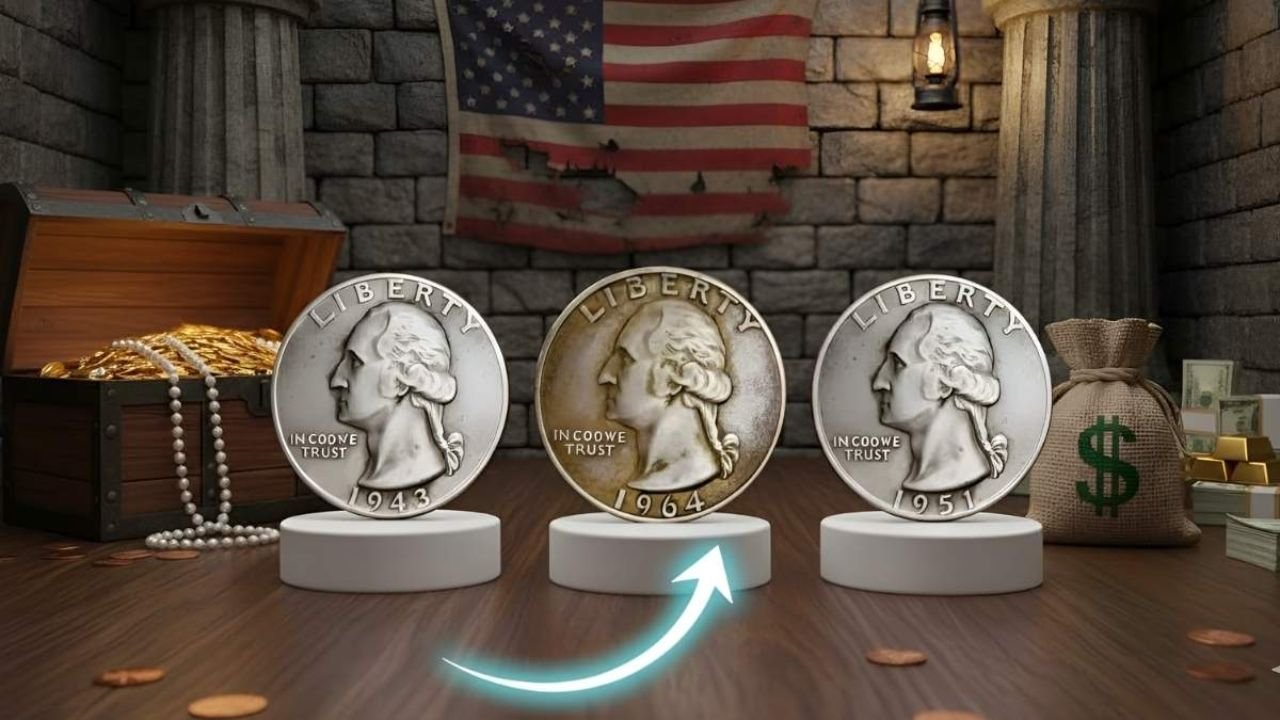
The Washington Quarter debuted in 1932 to honor the 200th anniversary of George Washington’s birth. Designed by John Flanagan, the coin features a dignified portrait of Washington on the obverse and a heraldic eagle on the reverse (for issues struck before 1999).
While billions of Washington Quarters have circulated across the United States, a select group stands apart for their rarity, minting errors, and historical significance. In today’s competitive numismatic market, certain examples can command prices approaching $50,700 depending on condition and demand.
Here’s a refined 2026 guide to nine Washington Quarters that serious collectors are actively pursuing.
Why Washington Quarters Remain Highly Collectible
Washington Quarters combine historical legacy with measurable scarcity. Key dates from the early 1930s, transitional silver issues, and dramatic mint errors all create strong value tiers within the series.
Three core drivers influence premium valuations:
- Low original mintage
- Recognizable mint errors or varieties
- Exceptional preservation (high Mint State or Proof grades)
As third-party grading and digital auction platforms expand globally, competition for elite examples continues to intensify.
1. 1932-D Washington Quarter
The 1932-D quarter is one of the foundational key dates of the series. Struck in Denver during the first year of issue, it had a relatively low mintage compared to later years.
High-grade specimens with sharp detail and minimal wear routinely sell between $20,000 and $30,000, with elite certified examples climbing significantly higher at major auctions.
2. 1932-S Washington Quarter
Minted in San Francisco, the 1932-S is another first-year rarity. Many surviving examples entered circulation, making high-grade coins particularly scarce.
Well-preserved specimens often achieve $15,000 to $25,000 in today’s market.
3. 1937 Doubled Die Obverse Quarter
This variety features noticeable doubling on inscriptions and date elements. The doubling is visible under magnification and remains one of the more dramatic early Washington Quarter errors.
Depending on clarity of the doubling and overall grade, values typically range from $5,000 to $10,000.
4. 1943-S Washington Quarter
Produced during World War II, the 1943-S quarter had a more limited mintage compared to surrounding years. While not rare in lower grades, sharply struck Mint State examples are considerably harder to locate.
Premium certified coins can bring $3,000 to $7,000.
5. 1950 D/S Overmintmark Quarter
The 1950 D/S quarter displays a Denver mint mark punched over a San Francisco mint mark. This visible overmintmark variety adds substantial appeal for specialists.
High-grade examples commonly trade between $4,000 and $8,000.
6. 1955 Doubled Die Quarter
Though not as widely known as other doubled dies in U.S. coinage, the 1955 Washington Quarter variety shows distinct doubling on obverse lettering.
Values generally fall between $2,000 and $5,000 depending on grade and doubling strength.
7. 1964 Proof Washington Quarter (Silver)
The 1964 issue marked the final year Washington Quarters were struck in 90% silver for circulation. Proof versions with deep cameo contrast and flawless surfaces are particularly desirable.
Exceptional examples range from $500 to $1,500, with ultra-high grades commanding stronger premiums.
8. 1970-S Proof Quarter Struck on Silver Planchet
This rare mint anomaly occurred when a proof quarter was struck on a silver planchet intended for other coinage. These transitional errors are scarce and highly collectible.
Certified specimens often sell between $1,500 and $3,000, with standout examples surpassing expectations.
9. 1983 Doubled Die Reverse Quarter
A modern variety, the 1983 doubled die reverse displays noticeable doubling in lettering on the reverse. Because fewer collectors preserved Mint State examples from the early 1980s, high-grade coins are surprisingly difficult to source.
Market values typically range from $700 to $1,200.
2026 Estimated Value Overview
Here is a simplified valuation snapshot based on strong market activity in 2026:
- 1932-D: $20,000–$30,000
- 1932-S: $15,000–$25,000
- 1937 Doubled Die Obverse: $5,000–$10,000
- 1943-S: $3,000–$7,000
- 1950 D/S: $4,000–$8,000
- 1955 Doubled Die: $2,000–$5,000
- 1964 Proof Silver: $500–$1,500
- 1970-S Silver Planchet Error: $1,500–$3,000
- 1983 Doubled Die Reverse: $700–$1,200
Final realized prices depend heavily on third-party grading certification, eye appeal, strike quality, and auction timing.
How to Identify a Valuable Washington Quarter
Serious collectors follow a disciplined evaluation process:
Examine Date and Mint Mark
Key dates such as 1932-D and 1932-S require careful mint mark inspection. Use magnification to confirm authenticity and positioning.
Look for Doubling and Overmintmarks
Strong lighting and a quality loupe help reveal doubled lettering or overlapping mint marks. Compare suspected varieties to verified reference images.
Evaluate Condition
Surface preservation dramatically affects value. Look for:
- Full hair detail in Washington’s portrait
- Sharp eagle feathers (pre-1999 issues)
- Clean fields free of heavy contact marks
- Original mint luster
Seek Professional Grading
For coins that appear promising, submission to a reputable grading service can significantly increase market liquidity and buyer confidence.
Hidden Wealth in Everyday Places
While most Washington Quarters remain common, discoveries still occur in inherited collections, estate holdings, and long-forgotten coin jars. Many early silver issues circulated heavily, yet overlooked Mint State coins occasionally surface.
The combination of history, scarcity, and the thrill of possibility continues to fuel global demand.
Investment Perspective for 2026 and Beyond
Rare Washington Quarters represent more than collectible artifacts. For affluent collectors and alternative asset investors, they offer:
- Tangible historical value
- Portfolio diversification
- Auction-driven upside potential
- Strong long-term collector demand
As authentication technologies advance and global participation expands, elite-condition key dates are expected to remain competitive.
Final Thoughts
The Washington Quarter series proves that everyday currency can evolve into a high-value collectible. Whether pursuing first-year rarities like the 1932-D and 1932-S, dramatic doubled dies, or transitional silver errors, disciplined research and professional grading remain essential.
For discerning collectors in 2026, these nine quarters represent some of the most compelling opportunities within classic American coinage — blending heritage, scarcity, and enduring financial appeal.