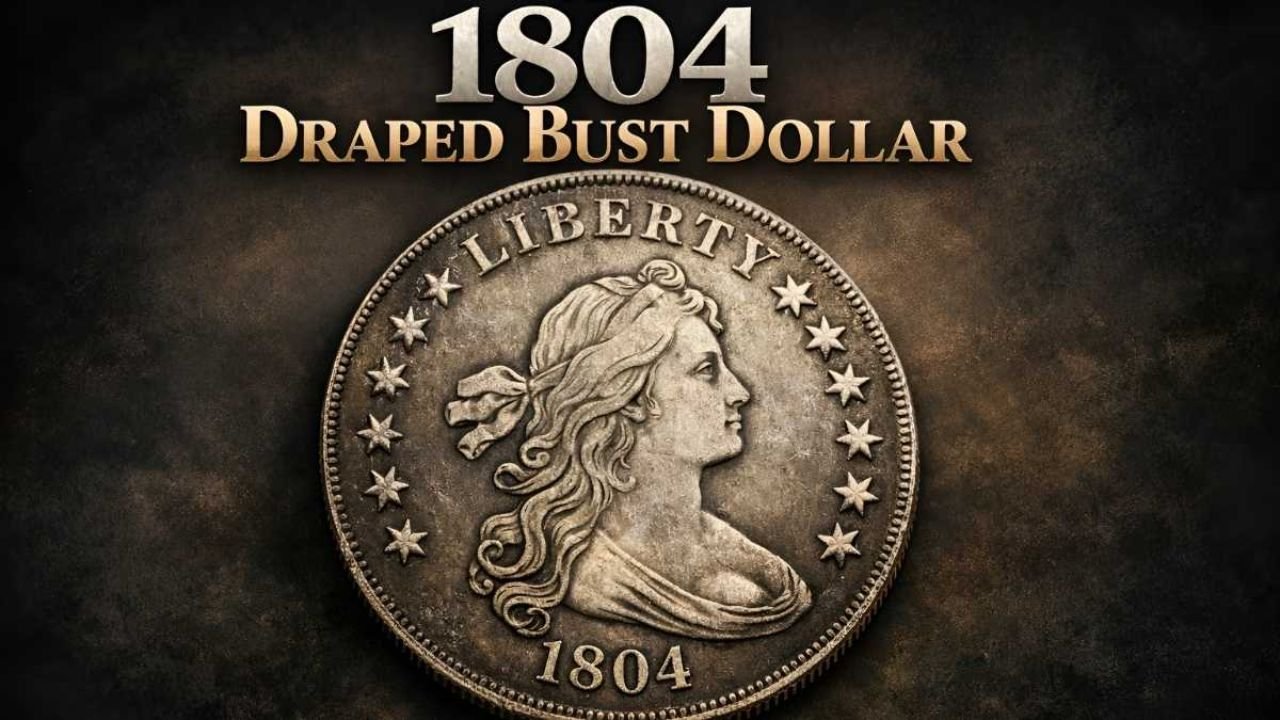
Few coins command the reverence, intrigue, and record-breaking prices of the 1804 Draped Bust Dollar. Often called the “King of American Coins,” this legendary silver dollar represents the pinnacle of rarity in United States numismatics.
Although it bears the date 1804, the coin’s true origin story begins decades later—adding a layer of mystery that has captivated elite collectors for generations.
For investors and connoisseurs of historic assets, the 1804 Draped Bust Dollar stands not merely as currency, but as a multimillion-dollar artifact of American history.
The Origins of the Draped Bust Dollar
The Draped Bust Dollar was introduced in 1795 during the early years of the United States Mint. Designed by Robert Scot, the coin features Liberty with flowing hair tied by a ribbon, draped in classical style. The reverse showcases a heraldic eagle—symbolizing national strength and unity.
These early silver dollars were substantial coins, struck in nearly 90% silver, and served as foundational pieces of America’s monetary system. Production continued through 1803, although official Mint records later contributed to confusion surrounding the famous 1804 date.
Why No Dollars Were Struck in 1804
Despite its inscription, no silver dollars were actually struck in 1804 for circulation. Regular production of Draped Bust Dollars effectively ceased after 1803.
The coins we now know as 1804 Dollars were first produced in 1834—three decades later. The reason was diplomatic.
The U.S. government prepared special proof sets intended as presentation gifts for foreign dignitaries. These sets were designed to showcase American coinage excellence and included examples of each denomination in current use.
Mint officials consulted historical production records, which indicated that silver dollars had last been struck in 1804 (based on reporting conventions of the time). Believing 1804 to be the final year of issue, they used that date on the newly prepared proof dollars.
This administrative misunderstanding gave birth to one of the most celebrated rarities in coin collecting history.
The Three Classes of 1804 Dollars
Today, collectors recognize three distinct classifications of the 1804 Draped Bust Dollar.
Class I – The Originals
Struck in 1834–1835 for diplomatic presentation sets, these are the most prestigious examples. Only eight Class I specimens are known to exist.
They were carefully produced as proof coins with mirrored surfaces and exceptional detail. Their documented origins and limited population make them the most valuable of all 1804 Dollars.
Class II – The Unique Restrike
In the 1850s, additional coins were clandestinely struck at the Mint for collectors. The Class II example differs slightly in edge lettering and planchet characteristics.
Only one Class II specimen is known, making it unique. Its rarity places it among the most important coins in American history.
Class III – The Later Restrikes
Also produced in the 1850s, these coins were struck for sale to collectors and dealers. Seven Class III examples are confirmed today.
Altogether, just fifteen specimens across all classes are known—an astonishingly small number for a U.S. coin of such prominence.
Record-Breaking Auction Values
The 1804 Draped Bust Dollar consistently ranks among the most expensive coins ever sold.
- Class I Originals have realized prices ranging from approximately $2.5 million to well over $7 million depending on grade and provenance.
- Class III Restrikes typically sell between $2 million and $5 million in major auctions.
- Class II, being unique, would likely command a price deep into the eight-figure range if offered publicly.
One of the finest known Class I specimens achieved a sale price of $7.68 million, solidifying its status as a trophy asset within global numismatics.
These valuations reflect far more than silver content. They represent rarity, history, and collector prestige at the highest level.
Why the 1804 Dollar Commands Such Prestige
Extreme Scarcity
With only fifteen known examples across all classes, supply is virtually nonexistent. Ownership opportunities are rare and often decades apart.
Diplomatic Heritage
Unlike typical circulation coins, the 1804 Dollar originated as a diplomatic gift. Its creation ties directly to early American foreign relations and national identity.
Numismatic Legend
For more than a century, the 1804 Dollar has been described as the ultimate prize in American coin collecting. Its mystique is reinforced by its unusual backstory and elite ownership history.
Investment Appeal
High-net-worth collectors view the coin as both a cultural artifact and a financial asset. Historically, elite American rarities have demonstrated resilience during economic uncertainty, attracting global bidders when they appear at auction.
Authentication and Provenance
Given its immense value, authentication is paramount. Every known specimen is carefully documented, with detailed provenance tracing ownership through prominent collections.
Professional grading services evaluate strike quality, preservation, and originality. Because population numbers are so small, each individual coin has its own identity within the collecting community.
For potential buyers, provenance can significantly influence value. Coins previously owned by legendary collectors often command premiums due to their historical association.
Accessible Alternatives for Collectors
While owning an 1804 Dollar is beyond the reach of most collectors, its legacy offers meaningful engagement opportunities.
Collectors may consider:
- Draped Bust Dollars from 1795–1803, which are historically significant yet more attainable
- Early U.S. silver coinage with strong eye appeal
- Studying auction catalogs and museum exhibits featuring 1804 specimens
Engaging with these related pieces provides a connection to the same formative era of American coinage.
Cultural and Historical Impact
The 1804 Draped Bust Dollar transcends its monetary denomination. It embodies early American ambition, artistic refinement, and diplomatic outreach.
Its story reflects the evolution of the United States Mint, the complexities of historical recordkeeping, and the enduring human fascination with rarity.
More than two centuries after the date it bears, the 1804 Dollar remains a symbol of prestige and aspiration within the global collecting community.
Final Thoughts
The 1804 Draped Bust Dollar is not merely a rare coin—it is a cornerstone of American numismatic heritage. Its unusual origin, microscopic surviving population, and multimillion-dollar valuations place it among the most important collectibles in the world.
For elite collectors, it represents the ultimate achievement. For historians, it offers insight into early U.S. diplomacy and minting practices. For investors, it demonstrates how scarcity and story can transform silver into legacy.
In every sense, the 1804 Draped Bust Dollar stands as the crown jewel of American coinage.